
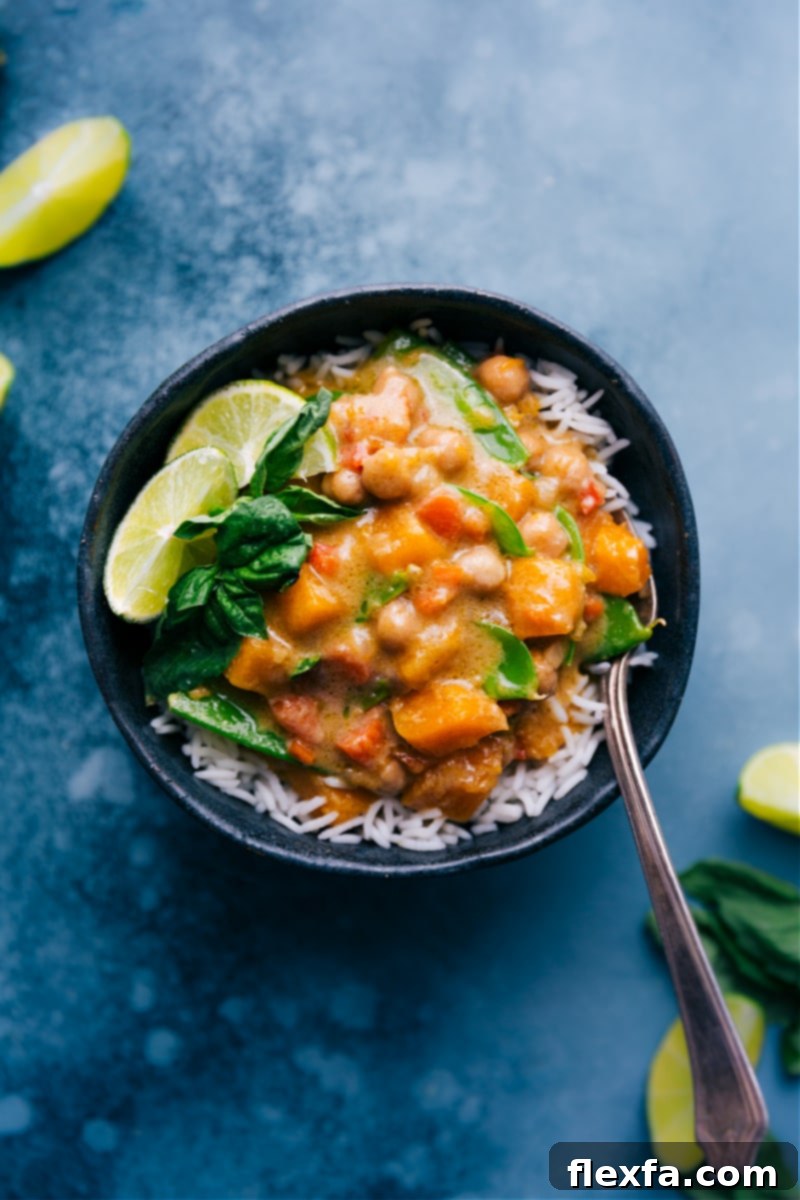
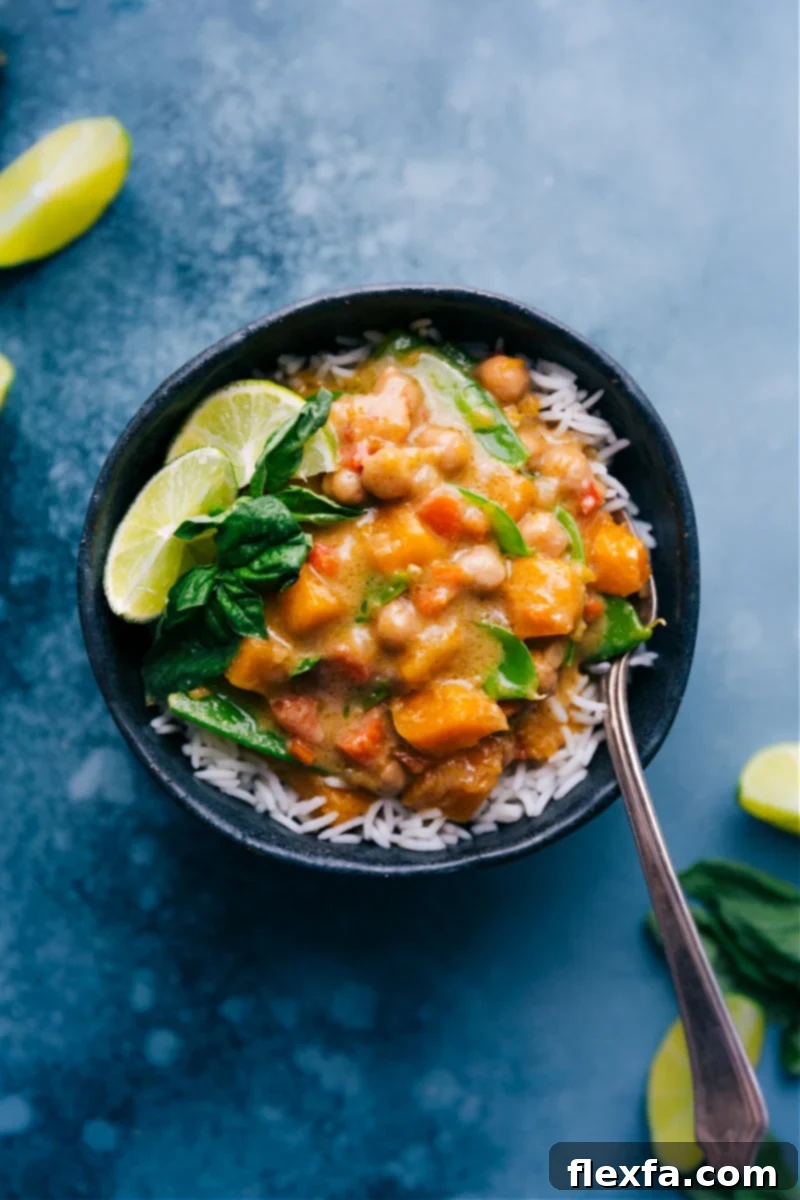
Vegetarian Thai Green Curry is a vibrant and deeply flavorful dish that brings the authentic tastes of Thailand right into your kitchen. Bursting with fresh, crisp vegetables like tender butternut squash and vibrant snow peas, this curry offers a comforting and utterly crave-worthy experience. Its rich, aromatic coconut base, infused with the unmistakable punch of green curry paste, creates a culinary masterpiece that is both satisfying and incredibly fresh. Perfect for a weeknight dinner or a special gathering, this vegetarian green curry promises a delightful journey for your taste buds, leaving you wanting more with every spoonful.

Author’s Note
Embark on a Flavorful Journey with this Vegetarian Thai Green Curry!
It all started a few weeks ago when my sister, an avid explorer of local culinary gems, raved about a new Thai restaurant. Her recommendation was specific and enthusiastic: I absolutely had to try their vegetarian Thai green curry. To be completely honest, I was initially skeptical. My usual preference leans towards heartier chicken or meat-based Thai dishes, and the idea of a solely vegetarian curry didn’t immediately pique my interest. However, I decided to humor her, ordering a selection of items to share with my family, including the much-touted vegetarian option.
To my genuine surprise, that first bite was nothing short of incredible! The curry was vibrant, rich, and bursting with complex flavors that completely won me over. I was instantly captivated. From that moment, I knew I had to recreate this magic in my own kitchen. I eagerly chatted with our server, gathering insights into the key ingredients and preparation techniques. Armed with newfound inspiration, I embarked on a mission to develop my own version, allowing me to savor those amazing flavors whenever the craving struck. Today, I can confidently say that this homemade Vegetarian Thai Green Curry has become a cherished staple and one of my absolute favorite dinners. It’s a testament to how unexpected culinary discoveries can lead to truly remarkable creations, proving that vegetarian dishes can be just as, if not more, satisfying and flavorful.
Demystifying Green Curry Paste: The Heart of the Dish
Green curry paste is undeniably the most crucial flavor component in this exquisite Thai green curry. Its vibrant green hue and complex aromatic profile are what define the dish’s unique character. Fortunately, what was once a specialty item is now readily available in most major grocery stores, making authentic Thai cooking more accessible than ever before.
- Where to find it: You’ll typically locate green curry paste in the international foods aisle of your local supermarket, often alongside other Asian ingredients. For an even wider selection and potentially more authentic brands, explore dedicated Asian markets. Online retailers are also an excellent resource if local options are limited.
- Choosing the right brand: When selecting a green curry paste, it’s essential to check the ingredient list, especially if you have dietary restrictions. Some traditional pastes may contain fish sauce or shrimp paste, which would not be suitable for a strictly vegetarian or vegan diet. For a reliably vegetarian option, Maesri and Thai Kitchen are highly recommended brands that deliver excellent flavor and are widely available.
- How much to use: The intensity of green curry paste can vary significantly between brands, so always consider this when adding it to your dish. For a robust and deeply flavored curry that stands up to the richness of coconut milk, we recommend using approximately 4 tablespoons of Maesri® curry paste. If you’re using Thai Kitchen® paste, you might need slightly more, around 5 to 6 tablespoons, to achieve a similar depth of flavor. Remember, the creamy sweetness of the coconut milk helps to balance the heat and intensity of the paste, allowing you to create a harmonious and incredibly delicious curry.
Essential Ingredients for Your Vegetarian Thai Green Curry
Crafting an exceptional Vegetarian Thai Green Curry relies on a thoughtful selection of ingredients. While many items are standard pantry staples, a few deserve special mention for their unique contributions to the flavor profile, along with helpful suggestions for substitutions:
- Kaffir lime leaves: These fragrant leaves impart a distinctive, bright citrus aroma that is integral to authentic Thai cuisine. While they elevate the dish beautifully, they can sometimes be challenging to find outside of Asian markets. If fresh Kaffir lime leaves are unavailable, don’t despair! You can still achieve a wonderful citrusy note by incorporating lime zest and fresh lime juice just before serving. This will brighten the curry and mimic some of the kaffir lime’s characteristic freshness.
- Fish sauce: Traditionally, fish sauce is a cornerstone of Thai curries, providing a crucial umami depth and savory complexity. For a truly vegetarian rendition, you’ll need a suitable substitute. Soy sauce (ensure it’s regular, not lite, for full flavor) or tamari (a gluten-free alternative) are excellent plant-based replacements that will deliver that essential savory punch without compromising your dietary preferences.
- Thai basil: With its distinct peppery, slightly anise-like flavor, Thai basil is the preferred herb for garnishing this curry, adding an aromatic finish. However, if Thai basil proves elusive, common garden variety basil can certainly be used. While the flavor profile will differ slightly, regular basil still contributes a lovely freshness.
- Lemongrass paste: This aromatic paste is a fantastic shortcut to infusing your curry with the bright, citrusy, and subtly minty notes of fresh lemongrass. While you might find fresh lemongrass stalks at larger grocery stores, the paste offers convenience without sacrificing much flavor. It’s frequently available in the refrigerated section of Asian markets or can be easily purchased online.
- Coconut milk: The base of any great Thai curry is rich, creamy coconut milk. For the best possible flavor and luxurious texture, always opt for full-fat canned coconut milk. Avoid “lite” versions, as they won’t provide the desired thickness or richness, resulting in a thinner, less satisfying curry. I personally favor Imperial Kitchen as it’s consistently rich and available in most grocery stores. The quality of your coconut milk can truly elevate your curry from good to outstanding.

Smart Shortcuts for a Quicker Prep
Life can get busy, but that doesn’t mean you have to sacrifice delicious, homemade meals. For those days when time is of the essence, here’s a fantastic shortcut to significantly reduce your prep time for this Vegetarian Thai Green Curry:
Pre-cut butternut squash: The most time-consuming part of preparing butternut squash is often the peeling and chopping. Many grocery stores now offer bags of pre-cut butternut squash in their produce section. This convenience item is a lifesaver! If the pieces appear too large for bite-sized curry chunks, simply take a few moments to cut them down a bit further. Smaller pieces will ensure they cook thoroughly and become fork-tender at the same rate as the other vegetables in your curry, creating a beautifully balanced texture throughout the dish. This simple hack allows you to enjoy a flavorful, wholesome meal with minimal fuss.

Storage Solutions for Your Curry
Maximizing Flavor: Storing Your Vegetarian Thai Green Curry
One of the many delights of curry recipes, and especially this Vegetarian Thai Green Curry, is how wonderfully they store. In fact, like many stews and flavorful dishes, the leftovers often become even more delicious and complex as the flavors meld and deepen over time. This makes it an ideal meal for meal prepping or simply enjoying throughout the week.
Refrigeration: To store any leftover curry, simply transfer it to an airtight container and place it in the fridge. It will stay fresh and flavorful for 3 to 5 days. When you’re ready to reheat, do so gently over low heat on the stovetop. The sauce may thicken slightly in the fridge; if it seems too thick for your preference, add a splash of vegetable broth, stock, or even water to achieve your desired consistency.
Freezing: This curry also freezes beautifully, making it perfect for long-term storage. Portion cooled leftovers into airtight, freezer-safe containers and store them for up to 3 months. When you’re ready to enjoy, thaw the curry completely in the refrigerator overnight before reheating it on the stovetop over low heat. Again, you can add a little liquid to thin the sauce if needed. Freezing allows you to enjoy the comforting flavors of this Thai Green Curry whenever a craving strikes, with minimal effort.
More Irresistible Vegetarian Recipes to Love!
Dinner
Vegetarian Chili Mac
Dinner
Chickpea Curry
Dinner
Vegetarian Gyros
Dinner
Vegetarian Enchiladas

Vegetarian Thai Green Curry
Chelsea Lords
30 minutes
30 minutes
1 hour
4
servings
Video
A video demonstration of this recipe is available at chelseasmessyapron.com.
Equipment
-
Large pot
Ingredients
- 2 tablespoons coconut oil
- 1 cup finely diced red onion (1 large red onion)
- 1 cup finely diced red bell pepper (1 bell pepper)
- 1 cup finely diced carrots (3 to 4 large carrots)
- 1 tablespoon minced garlic (4 cloves)
- 2 teaspoons minced ginger
- 1 tablespoon lemongrass paste (see Note 1)
- 1 teaspoon salt
- 4 tablespoons green curry paste (up to 6 tablespoons, see Note 2)
- 1-1/2 teaspoons ground coriander
- 3 cups butternut squash
- 1 (15.5-ounce) can chickpeas
- 2 (13.5-ounce) cans coconut milk (see Note 3)
- 8 Kaffir lime leaves (optional, see Note 4)
- 1-1/2 cups snow peas (trimmed and halved)
- 1-3 tablespoons light brown sugar (see Note 5)
- 1 tablespoon soy sauce (see Note 6)
- 1 to 2 tablespoons lime juice (to taste)
- Thai basil (or regular basil, for garnish)
- Cooked rice (optional, for serving)
- Warmed roti bread (optional, for serving)
Instructions
-
Begin by preparing your vegetables: finely dice the red onion, carrots, and red bell pepper. You can do this by hand for a rustic chop or use a food processor for a quicker, more uniform dice. Next, mince the garlic and ginger. For ginger, a spoon or vegetable peeler works wonders for removing the skin easily. Peel and chop the butternut squash into consistent bite-sized pieces, roughly 1/2-inch in size, to ensure even cooking. Finally, drain and rinse the canned chickpeas thoroughly under cold water.
-
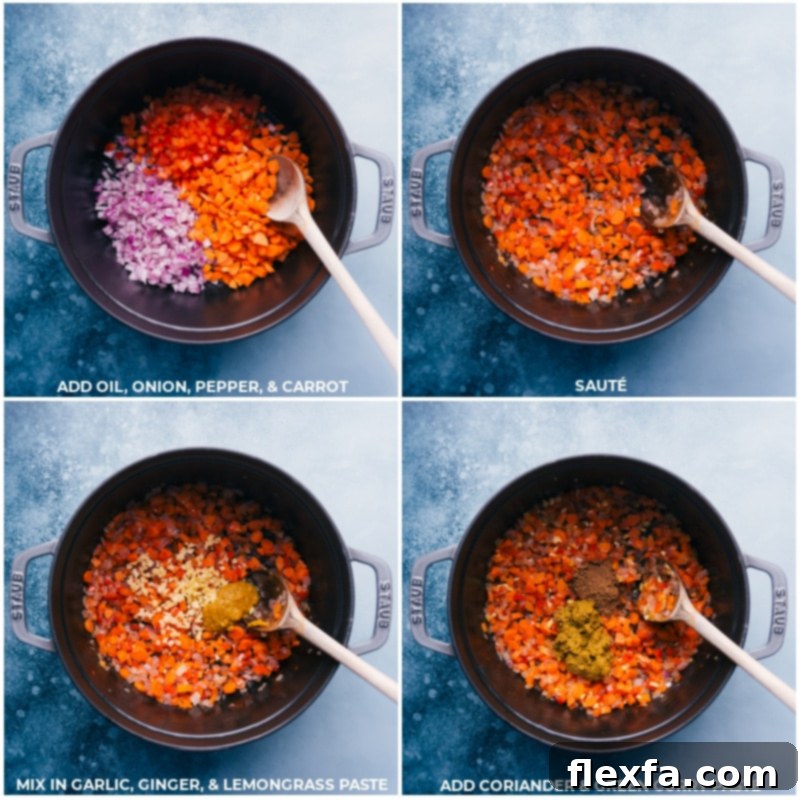
Heat the coconut oil in a large pot or Dutch oven over medium-high heat. Once shimmering, add the diced onion, carrots, and red pepper. Sauté these aromatics for 7 to 9 minutes, stirring occasionally, until the onions start to soften and turn a light golden color. This step builds the foundational flavor of your curry. Introduce the minced garlic, ginger, and lemongrass paste, stirring well to ensure all the vegetables are coated in the aromatic oil. Season to taste with salt at this stage; I typically add about 1 teaspoon. Reduce the heat to medium, then stir in the green curry paste and ground coriander. Continue to cook for 2 to 3 minutes, stirring frequently, until the paste is wonderfully fragrant and deeply aromatic. Add the drained chickpeas and butternut squash, stirring for 1 minute to coat them evenly with the curry paste.
-
Pour in both cans of full-fat coconut milk. Stir everything together, making sure to scrape the bottom of the pot to incorporate any flavorful bits and gently press the butternut squash below the liquid. Bring the mixture to a boil, then immediately reduce the heat to a rapid simmer – you want gentle bubbles around the edges, not a vigorous boil. Let it simmer, stirring occasionally, for 18 to 25 minutes. The goal is for the butternut squash to become fork-tender and the curry sauce to reduce and thicken. For me, this usually happens around the 20 to 22-minute mark. If the sauce is reducing too quickly and the squash isn’t tender, you can add a splash of vegetable stock/broth or water, and consider lowering the heat slightly. Conversely, if the squash isn’t tender and the sauce isn’t thickening, increase the heat a bit. Once the squash is tender, add the snow peas and cook for an additional 2 to 3 minutes, or until they are tender-crisp and bright green.
-
Now it’s time to fine-tune the flavors. Stir in the light brown sugar (start with a smaller amount and add more to taste), soy sauce, and 1 to 2 tablespoons of fresh lime juice. Feel free to adjust these ingredients to your personal preference: add more soy sauce for an enhanced savory or umami flavor, extra lime juice for a brighter, fresher tang, and more sugar if you find the curry too spicy or prefer a sweeter profile. Taste the curry and add more salt if necessary; I often find myself adding another 1/4 to 1/2 teaspoon. The flavors should be vibrant and well-balanced, a harmonious blend of sweet, sour, salty, and spicy.
-
Remove the finished curry from the heat. To serve, ladle generous portions into individual bowls. Garnish each bowl generously with fresh Thai basil (or regular basil if Thai basil is unavailable) and consider adding lime wedges on the side for an extra burst of freshness. This Vegetarian Thai Green Curry is wonderfully served over fluffy cooked rice and alongside warm roti bread, perfect for soaking up every last drop of the rich, flavorful sauce. Enjoy this delightful and satisfying meal!
Recipe Notes
Note 1: Lemongrass Paste
Lemongrass paste, while sometimes elusive, is a game-changer for adding incredible depth and a bright, citrusy essence to this curry. Its distinct flavor profile is hard to replicate. I’ve often found it readily available at my local Asian market, which tends to stock a wider array of specialty ingredients. For ultimate convenience, I frequently order lemongrass paste online. It’s a fantastic ingredient to keep on hand for various Asian-inspired dishes.
Note 2: Green Curry Paste Selection
The green curry paste is the absolute cornerstone of this dish’s flavor. You’ll typically find it in the international aisle of larger supermarkets or, for a broader selection, at an Asian grocery store. Online purchasing is also a reliable option. My personal favorite brand for its balanced flavor and heat is Maesri. I’ve also successfully tested this recipe with Thai Kitchen paste, another widely available option. It’s important to remember that the intensity and spice level of curry paste can vary significantly between brands. For Maesri, approximately 4 tablespoons usually provide a bold, well-rounded flavor. With Thai Kitchen, you might need 5 to 6 tablespoons to achieve a similar intensity. Both these quantities are designed to deliver rich, authentic flavors, with the sweetness of coconut milk helping to temper any excessive heat. If you’re unsure or sensitive to spice, always start with a slightly smaller amount and add more to your personal preference. You can always enhance flavor, but it’s much harder to reduce it!
Note 3: Coconut Milk for Creaminess
This recipe calls for 2 cans of full-fat coconut milk to achieve an ultra-rich, luxuriously thick, and creamy curry, reminiscent of what you’d find in authentic Thai restaurants. The high fat content contributes significantly to both flavor and texture. If you find two cans to be too much richness for your taste, you can opt to use 1 can of full-fat coconut milk and substitute the second can with 1 cup of vegetable stock or broth (or chicken stock if you are not strictly vegetarian). For best results, use full-fat coconut milk, as “lite” versions will result in a much thinner sauce and a less indulgent flavor profile. I recommend Imperial Kitchen® coconut milk for its consistent richness and widespread availability.
Note 4: Kaffir Lime Leaves
Kaffir lime leaves are a fantastic addition, imparting a vibrant, complex citrus fragrance that truly elevates Thai dishes. However, they can be quite difficult to source, often only found at specialized Asian markets. If you’re lucky enough to find them, crumple a few leaves to release their essential oils and add them to the curry when you pour in the coconut milk, removing them before serving. A great tip: if you do find Kaffir lime leaves, stock up! They freeze exceptionally well and can be pulled out whenever you need them. If fresh leaves aren’t an option, you can still achieve a lovely citrusy aroma by grating the zest of a fresh lime and squeezing in some lime juice just before serving.
Note 5: Adjusting Sweetness with Sugar
Brown sugar is added to this curry primarily to balance the spice from the green curry paste and to round out the overall flavor profile, contributing a subtle sweetness. The amount is entirely a matter of personal preference and how spicy your chosen curry paste is. I recommend starting with a smaller amount, perhaps 1 tablespoon, and then tasting the curry. You can gradually add more, up to 3 tablespoons, until you achieve your desired level of sweetness and balance. Some may find the curry perfectly balanced without any added sugar at all!
Note 6: Soy Sauce for Umami
Fish sauce is a traditional finishing ingredient in many Thai curries, renowned for its ability to add a layer of complex savory flavor and umami. Since this is a vegetarian recipe, we use soy sauce as an excellent plant-based alternative to achieve a similar depth of flavor. Ensure you use regular (not lite) soy sauce for the best results. If you are not vegetarian, feel free to substitute the soy sauce with fish sauce for a more traditional umami kick.
Storage: Optimal Flavor Enhancement Over Time
This curry truly shines as leftovers, with the flavors deepening and melding even further after a day or two. Store any remaining curry in an airtight container in the refrigerator for up to 3 to 5 days. When reheating, gently warm it over low heat on the stovetop. If the sauce has thickened during refrigeration, add a splash of vegetable broth/stock (or water) to achieve your desired consistency. For longer storage, freeze cooled leftovers in an airtight container for up to 3 months. Always defrost completely in the refrigerator before reheating on the stove. This makes it an excellent option for meal prep or quick future dinners.
Nutrition
Nutrition information is automatically calculated, so should only be used as an approximation.
Enjoyed this recipe? Share your thoughts below!